황폐한 사원에 걸린 달
And the Moon Sets over the Temple That Was
카메라는 경주 남산에 흩어져 있는 머리 없는 불상들을 찾아 길을 나선다. 무엇이, 누구에 의해 사라지고, 옮겨지고, 기록되어왔는가? 강과 바다와 산길을 사람들이 사진을 찍으며 거닐고 그곳에는 과거의 이미지들과 발굴의 욕망이 겹쳐진다.
The camera sets out on a journey to find the headless Buddha statues scattered across Namsan Mountain in Gyeongju. What has disappeared, who caused it to vanish, and how has it been recorded? People stroll along the river, the sea, and mountain paths, taking photographs, where images from the past and the desire for excavation overlap.
Screenings2025 EXiS(Experimental Film & Video Festival in Seoul), Seoul, South Korea
제22회 서울국제실험영화페스티벌
PublicationFunScreen - Taiwan Film and Audiovisual Institute, 2025
![]()
![]()
![]()
![]()
![]()
![]()
And the Moon Sets over the Temple That Was
HD, Color, Sound, 70'4'', 2025
카메라는 경주 남산에 흩어져 있는 머리 없는 불상들을 찾아 길을 나선다. 무엇이, 누구에 의해 사라지고, 옮겨지고, 기록되어왔는가? 강과 바다와 산길을 사람들이 사진을 찍으며 거닐고 그곳에는 과거의 이미지들과 발굴의 욕망이 겹쳐진다.
The camera sets out on a journey to find the headless Buddha statues scattered across Namsan Mountain in Gyeongju. What has disappeared, who caused it to vanish, and how has it been recorded? People stroll along the river, the sea, and mountain paths, taking photographs, where images from the past and the desire for excavation overlap.
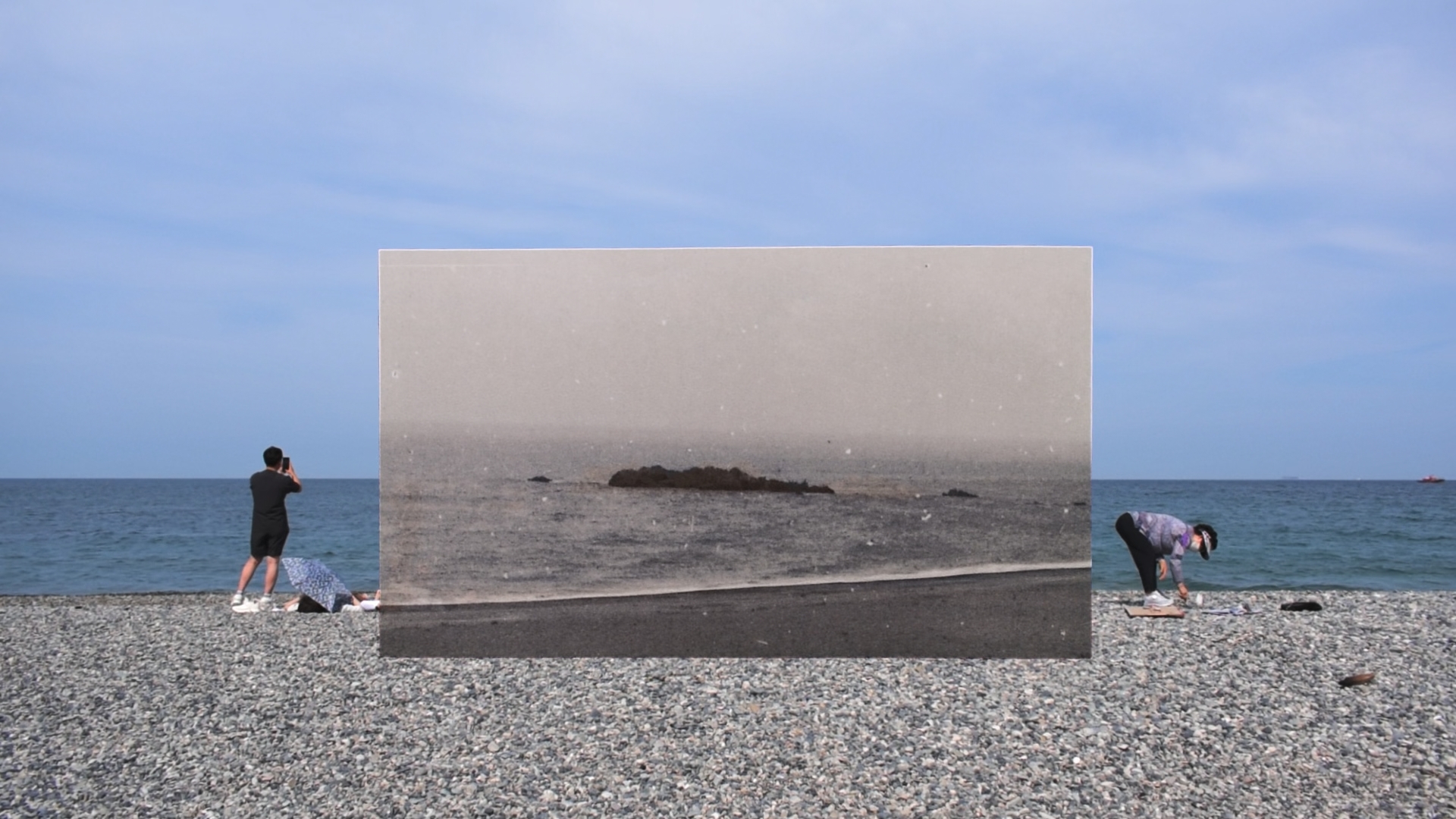
A few dozen metres offshore from a pebble beach, a small cluster of rocks juts out from the water. At first glance, there is nothing here worth stopping to look at, yet young Koreans arrive and strike a series of poses. But when a hand places an old photograph of the same spot over the scene, you begin to think that this place might be worth a closer look. The film won’t tell you that this is the location of the underwater tomb of the King of Silla, who unified Korea in the 7th century. The nature of the mounds that dot the landscape of the neighbouring city of Gyeongju; the structures rising there in the form of calabashes and pagodas; the reason you encounter so many decapitated Buddha statues there; or even the origin of the photographs superimposed over the landscapes, remain just as implicit. All the more so as the texts that appear on screen deliberately lead us down other paths: those of world exhibitions, creationist myths, the history of photographic techniques, and even archaeological digs.
Justin Jinsoo Kim, an experimental filmmaker trained in animation techniques at CalArts, is shooting his first feature film here, in his hometown, clearly relishing the slight sense of dissonance he is creating with the narrative form he has chosen, which undermines the meditative calm of his shots and the tranquillity of the soundtrack. This environment, composed of figures carved into the rock, majestic tombs with slumbering curves, temples and military fortifications, indigenous beliefs absorbed into Buddhist practices, ancient wars and colonial rule, gradually reveals a space saturated with heterogeneous temporalities. A historical palimpsest; or, to borrow Claude Debussy’s Orientalist title, and the source of the film’s title: an image that is at once simple and verbose, transparent and layered.
- Antoine Thirion, Cinéma du Réel
Justin Jinsoo Kim, an experimental filmmaker trained in animation techniques at CalArts, is shooting his first feature film here, in his hometown, clearly relishing the slight sense of dissonance he is creating with the narrative form he has chosen, which undermines the meditative calm of his shots and the tranquillity of the soundtrack. This environment, composed of figures carved into the rock, majestic tombs with slumbering curves, temples and military fortifications, indigenous beliefs absorbed into Buddhist practices, ancient wars and colonial rule, gradually reveals a space saturated with heterogeneous temporalities. A historical palimpsest; or, to borrow Claude Debussy’s Orientalist title, and the source of the film’s title: an image that is at once simple and verbose, transparent and layered.
- Antoine Thirion, Cinéma du Réel
Screenings
2026 Cinéma du Réel, Paris, France (2026.3.21-3.28)
시네마 뒤 레앨
시네마 뒤 레앨
2026 DMZ International Documentary Film Festival, Paju, South Korea
DMZ국제다큐멘터리영화제 (2026.9.10-9.16)
DMZ국제다큐멘터리영화제 (2026.9.10-9.16)
제22회 서울국제실험영화페스티벌
Publication
And the Moon Sets Over the Temple That Was — Justin Jinsoo Kim [Cinéma du Réel ’26 Review], In Review Online, by Sarp Sozdinler, March 26, 2026
Cinéma du Réel 2026 review: And the Moon Sets Over the Temple That Was (Justin Jinsoo Kim), International Cinephile Society, by Matthew Joseph Jenner, 2026
Entretien avec Justin Jinsoo Kim - And the Moon Sets over the Temple That Was, Le Club de Mediapart, Cinéma du réel, 2026
Entretien avec Justin Jinsoo Kim - And the Moon Sets over the Temple That Was, Le Club de Mediapart, Cinéma du réel, 2026

탄생의 기원이자 영원한 노스탤지어를 생성하는 고향은 무릇 화석화된 시공간처럼 간주된다. 그것은 어쩌면, 고향을 떠난 디아스포라의 순진무구한 희망일지도 모르겠다. <황폐한 사원에 걸린 달>은 김진수 감독이 자신의 고향 경주를 방문하여 머리 없는 불상들을 찾아 나서는 에세이이자, 삭제된 몸체에 카메라를 이식하고 애니메이션과 3D 기술을 장착하여 새로운 고향의 지도를 만드는 유희적인 하이브리드 다큐멘터리이다. 12·3 내란 사태 이후 한국에서 제작된 많은 다큐멘터리가 사람들의 얼굴을 포섭하는 데에 천착해왔다. 뉴스와 광장을 점령하다시피 했던 정치인, 활동가, 시민들의 얼굴은 이 시대를 상징하는 정치적인 이미지가 되었다. 김진수 감독은 그러한 열망으로부터 가장 멀리 떨어진 작가이다. 차이밍량의 <너의 얼굴 Your Face>(2018)이 사람의 얼굴을 시간이 축적된 오래된 풍경이자, 질 들뢰즈식으로 말하자면 결정체 이미지로 격상시켰다면, <황폐한 사원에 걸린 달>은 머리 없는 불상들, 눈과 코, 입 귀, 그리고 뇌에 이르는 감각기관이 사라진 신체를 전시하면서, 상상력을 그 자리로 불러들인다. 김진수는 뚫린 여백에 서서, 카메라와 애니메이션, 어린아이의 상상력을 포개 놓는다. <황폐한 사원에 걸린 달>이 완성하는 것은 경주의 옛 얼굴이 아니라, 저 멀리서 다가오는 미래의 고향이다.A hometown, the site of one’s origins and a source of perpetual nostalgia, is often imagined as a fossilized space-time. Perhaps this is the innocent hope of a diaspora that has left home behind. And the Moon Sets over the Temple That Was is an essay in which Justin Jinsoo Kim returns to his hometown of Gyeongju in search of headless Buddhist statues. Implanting the camera into these erased bodies and combining animation with 3D technology, he playfully constructs a new map of home.Many Korean documentaries made after the December 3, 2024 insurrection have sought to capture people’s faces. The faces of politicians, activists, and citizens that dominated the news and public squares became political images emblematic of the era. Kim stands far from such an impulse. If Tsai Ming-liang’s Your Face (2018) elevated the human face into an ancient landscape layered with time—a Deleuzian crystal-image—Kim instead presents headless statues, bodies deprived of eyes, noses, mouths, ears, and even brains, and summons imagination into those absences. Standing within these openings, he overlays camera, animation, and a childlike imagination. What the film ultimately creates is not the old face of Gyeongju, but a future hometown approaching from afar.
- DMZ Documentary Film Festival
- DMZ Documentary Film Festival